 Written by
Introduction
Publicly supported organizations exist at the intersection of governance, politics, and economics. Whether created by voter mandate or sustained through dedicated public funding, boards and commissions play a critical role in delivering quasi-governmental services that respond to community needs while maintaining political legitimacy and economic justification. Their effectiveness is measured not only by operational performance, but by their ability to demonstrate value—both tangible and intangible—to the regions they serve.
At the local and regional level, economic considerations shape nearly every policy and governance decision. Yet the underlying question is rarely limited to balance sheets alone. Instead, public investment invites a broader evaluation: Does this investment produce meaningful economic benefit, improve quality of life, and sustain public support? In this sense, economic impact becomes inseparable from political impact. Public organizations must continuously justify who benefits, how benefits are distributed, and why continued investment is warranted.
This analysis is structured around three interrelated functions that define the durability of public and quasi-public institutions:
- Governance, which ensures professional operations, accountability, and alignment with public purpose;
- Political function, which reflects constituency support, coalition strength, and legitimacy in public decision-making, which then meet the definition of who gets what and why; and
- Economic impact, which articulates how public investment circulates through and strengthens the regional economy.
Using these three functions as an analytical framework, this blog compares two economic impact studies produced by the Regional Arts Commission (RAC). Specifically, it examines the 2012 (Report IV) and 2025 (Report VI) studies—documents released during markedly different economic and political contexts. The 2012 report reflects conditions during the Great Recession, while the 2025 report emerges in a post-COVID recovery environment amid uncertainty surrounding federal arts funding.
By placing these two studies side by side, this comparison explores how RAC has used economic impact analysis as a strategic tool to communicate value, maintain political support, and reinforce its governance role within the St. Louis region. More broadly, it demonstrates how economic impact studies function not merely as technical reports, but as instruments that sustain public trust and institutional legitimacy across shifting economic and political landscapes.
Comparison of Regional Arts Commission of
St. Louis Economic Impact Studies
2012 and 2025
1. Overall Economic Impact: Strong Growth
| Measure | 2012 Study (FY2010) | 2025 Study (FY2022) | Change |
| Total Economic Activity | $582.3M | $868.7M | ▲ +$286.4M (~+49%) |
| Geography | St. Louis City & County | Greater St. Louis Area | Expanded regional scope |
| Context | During Great Recession | Post‑COVID recovery | Different economic climates |
Conclusion:
The arts and culture sector’s total economic footprint grew substantially between the two studies, even after adjusting for the fact that the later study occurs during pandemic recovery rather than economic expansion.
2. Employment Impact: Net Growth, but Slower Momentum
| Measure | 2012 | 2025 | Change |
| Total Jobs Supported | 18,983 | 11,986 | ▼ Decline |
| Arts‑Organization Jobs | 10,046 (FTE) | 8,169 (headcount) | ▼ Decline |
Important context:
- The 2012 study used Full‑Time Equivalent (FTE) jobs
- The 2025 study uses total job headcount (full‑time, part‑time, seasonal)
Conclusion:
While employment impact appears lower in 2025, this reflects:
- lingering pandemic job losses, and
- methodological differences between studies.
The 2025 report explicitly notes that recovery is ongoing and job levels have not fully rebounded.
3. Household Income: Significant Growth
| Measure | 2012 | 2025 | Change |
| Household Income Generated | $452.3M | $611.3M | ▲ +$159.0M (~+35%) |
Conclusion:
Despite fewer reported jobs, total household income rose sharply, indicating:
- higher wages,
- greater spending per job,
- and stronger economic multipliers per dollar spent.
4. Government Revenue: Major Expansion
| Measure | 2012 | 2025 | Change |
| Local Government Revenue | $28.3M | Included in $155.2M total | ▲ |
| State Government Revenue | $29.6M | Included in $155.2M total | ▲ |
| Total Tax Revenue | ~$57.9M (local + state) | $155.2M (local + state + federal) | ▲ Nearly 3× |
Conclusion:
The arts sector’s public‑sector fiscal return increased dramatically, strengthening the argument that arts funding produces measurable tax benefits at all government levels.
5. Audience Spending & Tourism: Mixed but Resilient
| Measure | 2012 | 2025 | Change |
| Total Attendance | 11.3M | 8.2M | ▼ Decline |
| Audience Spending (Total) | $269.1M | $289.4M | ▲ +$20.3M |
| Avg. Spend per Attendee | ~$23.76 | $35.74 | ▲ Significant increase |
| Non‑Local Attendees | 26.8% | 19.5% | ▼ Decline |
Interpretation:
- Fewer attendees, but
- much higher spending per person, especially among visitors
Conclusion:
Tourism volume declined post‑pandemic, but economic efficiency per attendee increased, meaning each visitor now contributes more to the local economy than in 2012.
6. Community & Social Impact: New Growth Area (2025 Only)
The 2012 study focused almost exclusively on economic metrics.
The 2025 study adds measured social impact:
| Indicator (2025) | Result |
| Community pride inspired | 89.0% |
| Would feel loss if venue closed | 84.9% |
| Venue seen as community pillar | 80.6% |
| Importance for future generations | 85.9% |
Conclusion:
This represents a major expansion of impact measurement, showing that arts and culture contribute not just economically but also to community cohesion, identity, and well‑being—an area not quantified in 2012.
7. Equity & Inclusion: New Findings in 2025
- No equity‑specific analysis in 2012
- 2025 study finds:
- Attendees at BIPOC/ALAANA‑serving organizations spend more per person than average
- Social impact levels are equal or higher than regional norms
Conclusion:
The 2025 study demonstrates that equitable investment does not reduce economic impact and may enhance it—an insight entirely absent from the earlier study.
8. Summary of Growth vs. Decline
Areas of Clear Growth
- ✅ Total economic activity
- ✅ Household income generated
- ✅ Tax revenue generated
- ✅ Audience spending per person
- ✅ Measurement of social and equity impacts
Areas of Decline or Constraint
- ⚠️ Total attendance
- ⚠️ Share of non‑local visitors
- ⚠️ Job counts (pandemic‑affected and methodologically different)
Bottom‑Line Comparative Conclusion
2012 conclusion:
The arts are an economic anchor that proved resilient during recession. The nonprofit arts and culture sector in St. Louis delivers measurable returns in employment, income, tourism, and public revenue, while enhancing quality of life and regional competitiveness.
2025 conclusion:
The arts are economic infrastructure and social capital, delivering higher total impact, stronger fiscal returns, and measurable community benefits—even while still recovering from a historic shock.
Overall takeaway:
Between 2012 and 2025, the arts in Greater St. Louis became more economically powerful per dollar and per attendee, more clearly tied to public revenue, and newly recognized for their social and equity impacts, despite pandemic‑related declines in attendance and employment.
Differences of Study Methodologies
1. Scope of What Is Measured
2012 Study (Arts & Economic Prosperity IV)
- Focused almost entirely on economic impact
- Core measures:
- Total economic activity
- Jobs (reported as Full‑Time Equivalent jobs)
- Household income
- Local and state government revenue
- Audience spending and tourism
- No formal measurement of social or community impact
2025 Study (Arts & Economic Prosperity 6)
- Measures both economic and social impact
- Adds new dimensions:
- Community pride
- Sense of loss if venues disappear
- Arts as community “pillars”
- Intergenerational value
- Equity and inclusion outcomes
Methodological shift:
The 2025 study intentionally expands beyond “dollars and jobs” to capture how arts and culture affect community well‑being, making it a broader, multidimensional impact study rather than a purely economic one.
2. Definition of Jobs
2012
- Jobs reported as Full‑Time Equivalent (FTE)
- Combines part‑time and full‑time labor into a single standardized unit
- Emphasizes labor volume
2025
- Jobs reported as total headcount
- Includes full‑time, part‑time, and seasonal jobs
- Reflects people employed, not labor hours
Why this matters:
A decline in job numbers between studies does not necessarily mean fewer people working fewer hours—it reflects a different counting method, compounded by pandemic‑era labor disruption.
3. Geographic Definition
2012
- Geography: St. Louis City and County
- More narrowly defined region
2025
- Geography: Greater St. Louis Area
- Explicitly defined and consistently applied across AEP6 regions
Methodological implication:
The later study uses a broader and more standardized regional definition, improving comparability across regions but complicating direct historical comparisons.
4. Audience Spending Measurement
2012
- Audience spending measured
- Lower average spending per attendee
- Smaller audience survey sample
- Fewer methodological controls described
2025
- Audience spending remains a core differentiator but:
- Larger survey sample
- Clear exclusion of on‑site spending to avoid double counting
- More detailed breakdown of local vs. non‑local spending
- Explicit travel‑purpose questions
Methodological improvement:
The 2025 study uses more refined audience‑intercept techniques, improving precision and reliability of tourism and spending estimates.
5. Treatment of Equity and Representation
2012
- No explicit equity framework
- Participation skewed toward larger, more established organizations
- No demographic or community‑of‑color analysis
2025
- Equity is methodologically embedded
- Includes:
- Intentional sampling of BIPOC/ALAANA‑serving organizations
- Multilingual surveys
- Equity‑focused participation targets
- Explicit caution against harmful comparisons
Methodological shift:
The 2025 study corrects for systemic underrepresentation in earlier studies, changing who is counted and whose impact is visible—this can affect totals and averages in meaningful ways.
6. Treatment of External Shocks (Recession vs. Pandemic)
2012
- Conducted after the Great Recession
- Results framed as resilience during economic downturn
- Study‑to‑study comparisons implied as valid
2025
- Conducted after COVID‑19
- Explicitly warns:
- Study‑to‑study comparisons are not recommended
- Pandemic caused structural disruption in attendance, staffing, and operations
Methodological stance change:
The 2025 study is more conservative and transparent about limitations in longitudinal comparison, whereas the 2012 study was more comfortable with trend comparison.
7. Underlying Economic Modeling
2012
- Used customized input‑output analysis
- Earlier generation of economic modeling tools
2025
- Uses IMPLAN platform
- More granular industry modeling
- Region‑specific economic “fingerprints”
- Higher computational rigor
Result:
The 2025 estimates are methodologically more precise, but not directly interchangeable with earlier model outputs.
Bottom‑Line Methodological Difference (Plain Language)
2012 study:
“How much money and how many jobs do the arts generate?”
2025 study:
“How do arts and culture function as an economic industry and as social infrastructure—and who benefits?”
Because of:
- different job definitions,
- expanded geography,
- new equity sampling,
- social‑impact measures,
- and post‑pandemic disruption
Summary
This blog compares two major economic impact studies conducted for the Regional Arts Commission (RAC)—the 2012 Arts & Economic Prosperity IV study and the 2025 Arts & Economic Prosperity 6 study—using a framework that integrates governance, political function, and economic impact. Examined side by side, the studies reveal how both the scale and the meaning of “impact” have evolved across two very different economic eras: the Great Recession and the post‑COVID recovery.
Across nearly all economic indicators, the arts and culture sector in Greater St. Louis demonstrates substantial growth. Total economic activity, household income, audience spending, and public tax revenue all increased markedly between the two studies. Even where declines appear—most notably in attendance and job counts—those shifts are shaped by pandemic disruption and important methodological differences, rather than by structural weakness in the sector. In fact, higher spending per attendee and stronger fiscal returns suggest that the sector has become more economically efficient over time.
The 2025 study also marks a significant shift in what is measured and valued. Unlike the 2012 study, which focused almost exclusively on dollars, jobs, and tax revenue, the later report incorporates social, community, and equity dimensions. Measures of community pride, perceived loss, intergenerational value, and equity outcomes position the arts not only as an economic engine, but as social infrastructure that supports cohesion, identity, and public wellbeing.
Taken together, the two studies show that economic impact analysis is not static. It reflects changing economic conditions, improved methodology, and evolving public expectations about accountability, inclusion, and value. For RAC, these studies function as more than technical reports—they are tools for governance, political legitimacy, and sustained public investment.
Much of what is written in the impact studies is to signal to constituents that all is well and resilient in tough times. RAC is funded through the St. Louis City and County hotel tax. Both studies include at least the amount arts visitors spend in this area. But, as the total number of visitors declined in 2025, RAC added categories in audience spending related to retail shopping, clothing and accessories, and miscellaneous. Many hotels have a gift shop.
They’re addressing both a political and an economic function through this data. The inclusion of equity and diversity of audience with their economic impact is similarly addressing a response to political and governance issues.
Conclusion
The comparison of RAC’s 2012 and 2025 economic impact studies illustrates how arts and culture have moved from being framed primarily as an economic asset to being understood as both economic infrastructure and civic capital. Over time, the sector has grown more productive per dollar invested, more transparent in how impact is measured, and more intentional about whose contributions and benefits are recognized. This is typical of responses to governance and political interests weighing in on the operations of an organization reliant on public funding.
Equally important, the evolution of these studies reflects a broader shift in public governance. In an environment of fiscal scrutiny, political polarization, and uncertainty around public funding, impact analysis serves as a bridge between numbers and public purpose. The 2012 study helped affirm the arts’ resilience during recession; the 2025 study extends that narrative by demonstrating recovery, adaptability, and social relevance after an unprecedented disruption.
Ultimately, this comparison underscores that the value of the arts cannot be reduced to attendance counts or job totals alone. Their true impact lies in how they circulate resources through the regional economy, return revenue to public systems, strengthen community identity, and contribute to a more inclusive civic landscape. For policymakers, funders, and the public, the lesson is clear: sustained investment in arts and culture is not merely a discretionary expense—it is a strategic investment in economic vitality, democratic legitimacy, and the long-term wellbeing of the St. Louis region.
(Author’s note: Much of the data presented is based on audience self assessed surveys. The sample of 1,973 audience members includes 401 members identified in the BIPOC/ALAANA communities in the 2025 survey)
Governance and Political Considerations
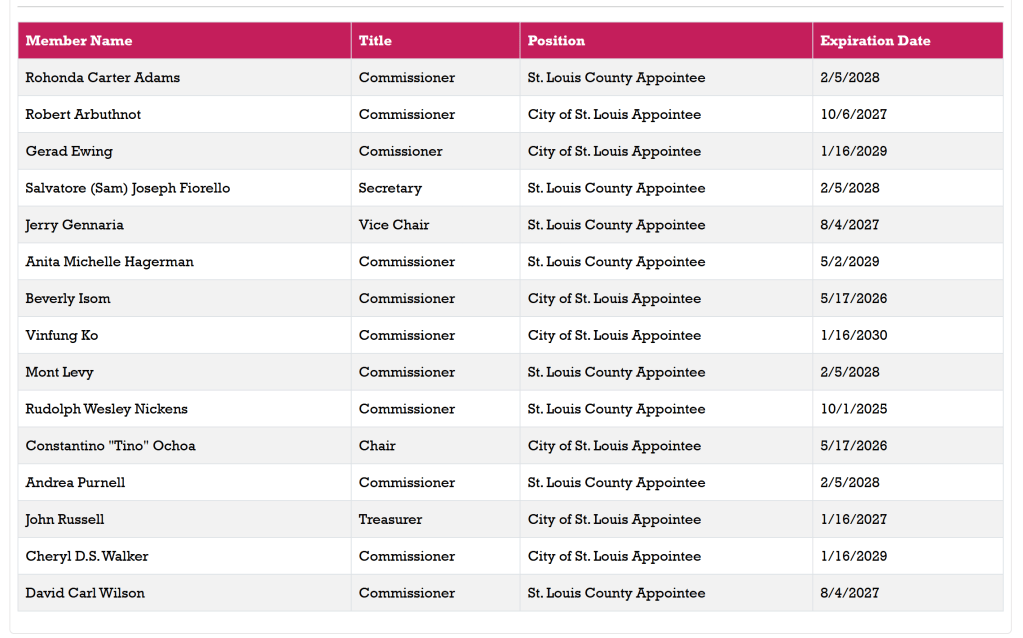
Above is a list of current appointees to the Regional Arts Commission appointees with title, who they represent and expiration of their term from the county boards and commissions page. St. Louis City has similar information on their website with regards to operations and duties.
Organizational Structure Summary: Political, Economic, and Governance Considerations for the Regional Arts Commission
The Regional Arts Commission (RAC), legally established under state law as the Regional Cultural and Performing Arts Development District, operates within a multi-jurisdictional governance structure that reflects both political representation and economic purpose. Its structure, authority, and functions are shaped by statutory mandates, public appointments, and its role in regional cultural development.
Governance Structure
The Commission is composed of fifteen members, with eight appointees representing St. Louis County and seven representing the City of St. Louis. All members are appointed by the chief executive of their respective jurisdictions. This structure embeds the organization within a formal layer of public governance, linking its operations directly to elected leadership and state-authorized oversight. Because the Commission exists by statute, its activities and performance are subject to scrutiny not only at the local level but also by state legislators, creating an environment where organizational challenges can quickly escalate into public or political concerns.
Political Considerations
The RAC’s mandate to unify cultural and performing arts organizations across the region carries inherent political dimensions. By organizing and supporting a broad arts constituency, the Commission functions as a coalition-builder that aligns cultural stakeholders with public officials and major funding interests. This alignment can strengthen regional advocacy for the arts but also exposes the organization to political pressures. Any operational failures or controversies risk becoming politicized, particularly given the ability of legislators and other officials to intervene or amplify concerns.
Economic Considerations
Economically, the Commission plays a central role in stewarding public funding mechanisms, including revenues derived from hotel and motel taxes. Its mission links cultural development with regional economic impact, positioning the arts as both a public good and an economic driver. Political instability or governance challenges can therefore have direct economic consequences, potentially undermining funder confidence, discouraging participation, or threatening the sustainability of supported organizations.
Interdependence and Organizational Stability
Political, economic, and governance functions within the RAC are closely interdependent. Disruption in one area can destabilize the others, increasing organizational risk. In such circumstances, leadership intervention is often required to restore stability. These interventions frequently involve change agents who may pursue adjustments in operations, policy, or personnel to address underlying dysfunction and reestablish organizational credibility.
 The Structure of Society