
Demonstration of Governance, Political, and Economic Functional Impact Using the Regional Arts Commission

Introduction

Publicly supported organizations exist at the intersection of governance, politics, and economics. Whether created by voter mandate or sustained through dedicated public funding, boards and commissions play a critical role in delivering quasi-governmental services that respond to community needs while maintaining political legitimacy and economic justification. Their effectiveness is measured not only by operational performance, but by their ability to demonstrate value—both tangible and intangible—to the regions they serve.

At the local and regional level, economic considerations shape nearly every policy and governance decision. Yet the underlying question is rarely limited to balance sheets alone. Instead, public investment invites a broader evaluation: Does this investment produce meaningful economic benefit, improve quality of life, and sustain public support? In this sense, economic impact becomes inseparable from political impact. Public organizations must continuously justify who benefits, how benefits are distributed, and why continued investment is warranted.

This analysis is structured around three interrelated functions that define the durability of public and quasi-public institutions:

  1. Governance, which ensures professional operations, accountability, and alignment with public purpose;
  2. Political function, which reflects constituency support, coalition strength, and legitimacy in public decision-making, which then meet the definition of who gets what and why; and
  3. Economic impact, which articulates how public investment circulates through and strengthens the regional economy.

Using these three functions as an analytical framework, this blog compares two economic impact studies produced by the Regional Arts Commission (RAC). Specifically, it examines the 2012 (Report IV) and 2025 (Report VI) studies—documents released during markedly different economic and political contexts. The 2012 report reflects conditions during the Great Recession, while the 2025 report emerges in a post-COVID recovery environment amid uncertainty surrounding federal arts funding.

By placing these two studies side by side, this comparison explores how RAC has used economic impact analysis as a strategic tool to communicate value, maintain political support, and reinforce its governance role within the St. Louis region. More broadly, it demonstrates how economic impact studies function not merely as technical reports, but as instruments that sustain public trust and institutional legitimacy across shifting economic and political landscapes.

Comparison of Regional Arts Commission of

St. Louis Economic Impact Studies

2012 and 2025

1. Overall Economic Impact: Strong Growth

Measure2012 Study (FY2010)2025 Study (FY2022)Change
Total Economic Activity$582.3M$868.7M▲ +$286.4M (~+49%)
GeographySt. Louis City & CountyGreater St. Louis AreaExpanded regional scope
ContextDuring Great RecessionPost‑COVID recoveryDifferent economic climates

Conclusion:
The arts and culture sector’s total economic footprint grew substantially between the two studies, even after adjusting for the fact that the later study occurs during pandemic recovery rather than economic expansion.


2. Employment Impact: Net Growth, but Slower Momentum

Measure20122025Change
Total Jobs Supported18,98311,986▼ Decline
Arts‑Organization Jobs10,046 (FTE)8,169 (headcount)▼ Decline

Important context:

  • The 2012 study used Full‑Time Equivalent (FTE) jobs
  • The 2025 study uses total job headcount (full‑time, part‑time, seasonal)

Conclusion:
While employment impact appears lower in 2025, this reflects:

  • lingering pandemic job losses, and
  • methodological differences between studies.

The 2025 report explicitly notes that recovery is ongoing and job levels have not fully rebounded.


3. Household Income: Significant Growth

Measure20122025Change
Household Income Generated$452.3M$611.3M▲ +$159.0M (~+35%)

Conclusion:
Despite fewer reported jobs, total household income rose sharply, indicating:

  • higher wages,
  • greater spending per job,
  • and stronger economic multipliers per dollar spent.

4. Government Revenue: Major Expansion

Measure20122025Change
Local Government Revenue$28.3MIncluded in $155.2M total
State Government Revenue$29.6MIncluded in $155.2M total
Total Tax Revenue~$57.9M (local + state)$155.2M (local + state + federal)▲ Nearly 3×

Conclusion:
The arts sector’s public‑sector fiscal return increased dramatically, strengthening the argument that arts funding produces measurable tax benefits at all government levels.


5. Audience Spending & Tourism: Mixed but Resilient

Measure20122025Change
Total Attendance11.3M8.2M▼ Decline
Audience Spending (Total)$269.1M$289.4M▲ +$20.3M
Avg. Spend per Attendee~$23.76$35.74▲ Significant increase
Non‑Local Attendees26.8%19.5%▼ Decline

Interpretation:

  • Fewer attendees, but
  • much higher spending per person, especially among visitors

Conclusion:
Tourism volume declined post‑pandemic, but economic efficiency per attendee increased, meaning each visitor now contributes more to the local economy than in 2012.


6. Community & Social Impact: New Growth Area (2025 Only)

The 2012 study focused almost exclusively on economic metrics.
The 2025 study adds measured social impact:

Indicator (2025)Result
Community pride inspired89.0%
Would feel loss if venue closed84.9%
Venue seen as community pillar80.6%
Importance for future generations85.9%

Conclusion:
This represents a major expansion of impact measurement, showing that arts and culture contribute not just economically but also to community cohesion, identity, and well‑being—an area not quantified in 2012.


7. Equity & Inclusion: New Findings in 2025

  • No equity‑specific analysis in 2012
  • 2025 study finds:
    • Attendees at BIPOC/ALAANA‑serving organizations spend more per person than average
    • Social impact levels are equal or higher than regional norms

Conclusion:
The 2025 study demonstrates that equitable investment does not reduce economic impact and may enhance it—an insight entirely absent from the earlier study.


8. Summary of Growth vs. Decline

Areas of Clear Growth

  • ✅ Total economic activity
  • ✅ Household income generated
  • ✅ Tax revenue generated
  • ✅ Audience spending per person
  • ✅ Measurement of social and equity impacts

Areas of Decline or Constraint

  • ⚠️ Total attendance
  • ⚠️ Share of non‑local visitors
  • ⚠️ Job counts (pandemic‑affected and methodologically different)

Bottom‑Line Comparative Conclusion

2012 conclusion:

The arts are an economic anchor that proved resilient during recession. The nonprofit arts and culture sector in St. Louis delivers measurable returns in employment, income, tourism, and public revenue, while enhancing quality of life and regional competitiveness.

2025 conclusion:

The arts are economic infrastructure and social capital, delivering higher total impact, stronger fiscal returns, and measurable community benefits—even while still recovering from a historic shock.

Overall takeaway:
Between 2012 and 2025, the arts in Greater St. Louis became more economically powerful per dollar and per attendee, more clearly tied to public revenue, and newly recognized for their social and equity impacts, despite pandemic‑related declines in attendance and employment.

Differences of Study Methodologies

1. Scope of What Is Measured

2012 Study (Arts & Economic Prosperity IV)

  • Focused almost entirely on economic impact
  • Core measures:
    • Total economic activity
    • Jobs (reported as Full‑Time Equivalent jobs)
    • Household income
    • Local and state government revenue
    • Audience spending and tourism
  • No formal measurement of social or community impact

2025 Study (Arts & Economic Prosperity 6)

  • Measures both economic and social impact
  • Adds new dimensions:
    • Community pride
    • Sense of loss if venues disappear
    • Arts as community “pillars”
    • Intergenerational value
    • Equity and inclusion outcomes

Methodological shift:
The 2025 study intentionally expands beyond “dollars and jobs” to capture how arts and culture affect community well‑being, making it a broader, multidimensional impact study rather than a purely economic one.


2. Definition of Jobs

2012

  • Jobs reported as Full‑Time Equivalent (FTE)
    • Combines part‑time and full‑time labor into a single standardized unit
  • Emphasizes labor volume

2025

  • Jobs reported as total headcount
    • Includes full‑time, part‑time, and seasonal jobs
  • Reflects people employed, not labor hours

Why this matters:
A decline in job numbers between studies does not necessarily mean fewer people working fewer hours—it reflects a different counting method, compounded by pandemic‑era labor disruption.


3. Geographic Definition

2012

  • Geography: St. Louis City and County
  • More narrowly defined region

2025

  • Geography: Greater St. Louis Area
  • Explicitly defined and consistently applied across AEP6 regions

Methodological implication:
The later study uses a broader and more standardized regional definition, improving comparability across regions but complicating direct historical comparisons.


4. Audience Spending Measurement

2012

  • Audience spending measured
  • Lower average spending per attendee
  • Smaller audience survey sample
  • Fewer methodological controls described

2025

  • Audience spending remains a core differentiator but:
    • Larger survey sample
    • Clear exclusion of on‑site spending to avoid double counting
    • More detailed breakdown of local vs. non‑local spending
    • Explicit travel‑purpose questions

Methodological improvement:
The 2025 study uses more refined audience‑intercept techniques, improving precision and reliability of tourism and spending estimates.


5. Treatment of Equity and Representation

2012

  • No explicit equity framework
  • Participation skewed toward larger, more established organizations
  • No demographic or community‑of‑color analysis

2025

  • Equity is methodologically embedded
  • Includes:
    • Intentional sampling of BIPOC/ALAANA‑serving organizations
    • Multilingual surveys
    • Equity‑focused participation targets
    • Explicit caution against harmful comparisons

Methodological shift:
The 2025 study corrects for systemic underrepresentation in earlier studies, changing who is counted and whose impact is visible—this can affect totals and averages in meaningful ways.


6. Treatment of External Shocks (Recession vs. Pandemic)

2012

  • Conducted after the Great Recession
  • Results framed as resilience during economic downturn
  • Study‑to‑study comparisons implied as valid

2025

  • Conducted after COVID‑19
  • Explicitly warns:
    • Study‑to‑study comparisons are not recommended
    • Pandemic caused structural disruption in attendance, staffing, and operations

Methodological stance change:
The 2025 study is more conservative and transparent about limitations in longitudinal comparison, whereas the 2012 study was more comfortable with trend comparison.


7. Underlying Economic Modeling

2012

  • Used customized input‑output analysis
  • Earlier generation of economic modeling tools

2025

  • Uses IMPLAN platform
  • More granular industry modeling
  • Region‑specific economic “fingerprints”
  • Higher computational rigor

Result:
The 2025 estimates are methodologically more precise, but not directly interchangeable with earlier model outputs.


Bottom‑Line Methodological Difference (Plain Language)

2012 study:

“How much money and how many jobs do the arts generate?”

2025 study:

“How do arts and culture function as an economic industry and as social infrastructure—and who benefits?”

Because of:

  • different job definitions,
  • expanded geography,
  • new equity sampling,
  • social‑impact measures,
  • and post‑pandemic disruption

Summary

This blog compares two major economic impact studies conducted for the Regional Arts Commission (RAC)—the 2012 Arts & Economic Prosperity IV study and the 2025 Arts & Economic Prosperity 6 study—using a framework that integrates governance, political function, and economic impact. Examined side by side, the studies reveal how both the scale and the meaning of “impact” have evolved across two very different economic eras: the Great Recession and the post‑COVID recovery.

Across nearly all economic indicators, the arts and culture sector in Greater St. Louis demonstrates substantial growth. Total economic activity, household income, audience spending, and public tax revenue all increased markedly between the two studies. Even where declines appear—most notably in attendance and job counts—those shifts are shaped by pandemic disruption and important methodological differences, rather than by structural weakness in the sector. In fact, higher spending per attendee and stronger fiscal returns suggest that the sector has become more economically efficient over time.

The 2025 study also marks a significant shift in what is measured and valued. Unlike the 2012 study, which focused almost exclusively on dollars, jobs, and tax revenue, the later report incorporates social, community, and equity dimensions. Measures of community pride, perceived loss, intergenerational value, and equity outcomes position the arts not only as an economic engine, but as social infrastructure that supports cohesion, identity, and public wellbeing.

Taken together, the two studies show that economic impact analysis is not static. It reflects changing economic conditions, improved methodology, and evolving public expectations about accountability, inclusion, and value. For RAC, these studies function as more than technical reports—they are tools for governance, political legitimacy, and sustained public investment.

Much of what is written in the impact studies is to signal to constituents that all is well and resilient in tough times.  RAC is funded through the St. Louis City and County hotel tax.  Both studies include at least the amount arts visitors spend in this area.  But, as the total number of visitors declined in 2025, RAC added categories in audience spending related to retail shopping, clothing and accessories, and miscellaneous.  Many hotels have a gift shop.

They’re addressing both a political and an economic function through this data.  The inclusion of equity and diversity of audience with their economic impact is similarly addressing a response to political and governance issues. 


Conclusion

The comparison of RAC’s 2012 and 2025 economic impact studies illustrates how arts and culture have moved from being framed primarily as an economic asset to being understood as both economic infrastructure and civic capital. Over time, the sector has grown more productive per dollar invested, more transparent in how impact is measured, and more intentional about whose contributions and benefits are recognized. This is typical of responses to governance and political interests weighing in on the operations of an organization reliant on public funding.

Equally important, the evolution of these studies reflects a broader shift in public governance. In an environment of fiscal scrutiny, political polarization, and uncertainty around public funding, impact analysis serves as a bridge between numbers and public purpose. The 2012 study helped affirm the arts’ resilience during recession; the 2025 study extends that narrative by demonstrating recovery, adaptability, and social relevance after an unprecedented disruption.

Ultimately, this comparison underscores that the value of the arts cannot be reduced to attendance counts or job totals alone. Their true impact lies in how they circulate resources through the regional economy, return revenue to public systems, strengthen community identity, and contribute to a more inclusive civic landscape. For policymakers, funders, and the public, the lesson is clear: sustained investment in arts and culture is not merely a discretionary expense—it is a strategic investment in economic vitality, democratic legitimacy, and the long-term wellbeing of the St. Louis region.

(Author’s note: Much of the data presented is based on audience self assessed surveys. The sample of 1,973 audience members includes 401 members identified in the BIPOC/ALAANA communities in the 2025 survey)

Governance and Political Considerations
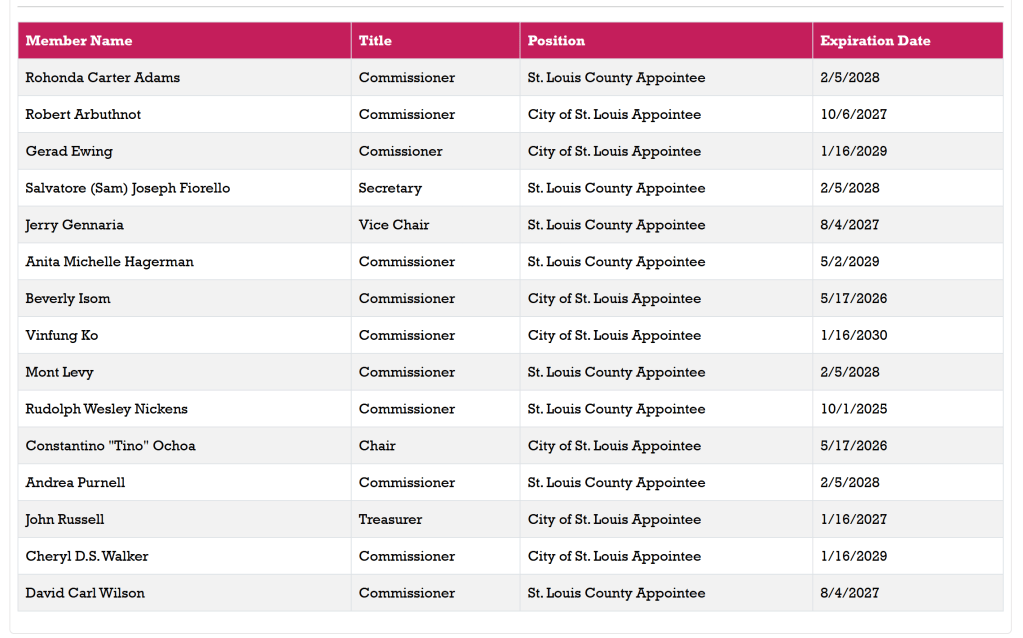
List of appointees to the Regional Arts Commission appointees with title, who they represent and expiration of their term.

Above is a list of current appointees to the Regional Arts Commission appointees with title, who they represent and expiration of their term from the county boards and commissions page. St. Louis City has similar information on their website with regards to operations and duties.

Organizational Structure Summary: Political, Economic, and Governance Considerations for the Regional Arts Commission

The Regional Arts Commission (RAC), legally established under state law as the Regional Cultural and Performing Arts Development District, operates within a multi-jurisdictional governance structure that reflects both political representation and economic purpose. Its structure, authority, and functions are shaped by statutory mandates, public appointments, and its role in regional cultural development.

Governance Structure
The Commission is composed of fifteen members, with eight appointees representing St. Louis County and seven representing the City of St. Louis. All members are appointed by the chief executive of their respective jurisdictions. This structure embeds the organization within a formal layer of public governance, linking its operations directly to elected leadership and state-authorized oversight. Because the Commission exists by statute, its activities and performance are subject to scrutiny not only at the local level but also by state legislators, creating an environment where organizational challenges can quickly escalate into public or political concerns.

Political Considerations
The RAC’s mandate to unify cultural and performing arts organizations across the region carries inherent political dimensions. By organizing and supporting a broad arts constituency, the Commission functions as a coalition-builder that aligns cultural stakeholders with public officials and major funding interests. This alignment can strengthen regional advocacy for the arts but also exposes the organization to political pressures. Any operational failures or controversies risk becoming politicized, particularly given the ability of legislators and other officials to intervene or amplify concerns.

Economic Considerations
Economically, the Commission plays a central role in stewarding public funding mechanisms, including revenues derived from hotel and motel taxes. Its mission links cultural development with regional economic impact, positioning the arts as both a public good and an economic driver. Political instability or governance challenges can therefore have direct economic consequences, potentially undermining funder confidence, discouraging participation, or threatening the sustainability of supported organizations.

Interdependence and Organizational Stability
Political, economic, and governance functions within the RAC are closely interdependent. Disruption in one area can destabilize the others, increasing organizational risk. In such circumstances, leadership intervention is often required to restore stability. These interventions frequently involve change agents who may pursue adjustments in operations, policy, or personnel to address underlying dysfunction and reestablish organizational credibility.


Unlocking Fiscal Benefits: St. Louis County and City Collaboration

Ever since the Great Divorce St. Louis City and County have been looking for ways to get back together, in one way or another. As government and the economy has gotten more complex it has become a reality that they need each other. Conversations around cost sharing began to happen and eventually the Missouri Council for a Better Economy solicited a study for City-County collaboration focused on cost sharing.

Essentially, they were looking to find opportunities for economies of scale between the entities. Collaboration without a vote of the people. The following is a summary of key pieces of the executive summary of that report with a downloadable policy brief. St. Louis County enjoys a fairly high rate of purchasing power, in part because it has minimalities within to partner with to help drive down costs. Budgetary constraints or storage capacity in the city often prevent the single entity from flexing the same muscle.

A former chief executive relayed this example years ago. He said road salt is a good example, and this is somewhat hypothetical at this time as it may be the city and county are collaborating more closely when it comes to salt. Municipalities and county transportation use salt on roads and the county has storage capacity to purchase for the estimated need of the whole winter season. This drives down costs significantly. St. Louis City, on the other hand, may have to buy a barge at a time, over time, to spread out the costs because they are at capacity.

St. Louis County government maintains what is referred to the matrix. It’s a spreadsheet of every agreement it has with municipalities to provide services such as inspections, plan review, and police support. This improves capacity for St. Louis County, creates efficiency of service and provides for better purchasing power. They do this in a number of areas. On the other hand, St. Louis City is often left to their own devices, which leads to higher costs with a constrained tax base. It should be pointed out that St. Louis City has been growing that tax base significantly in the last decade. But the economic constraints remain and collaboration would go a long way in burden sharing in the region.

City of St. Louis and St. Louis County Intergovernmental Collaboration StudyThe PFM Group

Key Context and Issues –

1. Structural Fragmentation

  • Missouri has an unusually high number of local governments, including counties, municipalities, special districts, and school districts.
  • The City–County separation (1876) created rigid boundaries with limited flexibility for addressing shared regional challenges.
  • Multiple constitutional amendments (1924, 1945, 1966) created legal pathways for cooperation or consolidation, but all consolidation efforts have failed due to insufficient support.

2. Fiscal Pressure as a Catalyst

  • The 2008–2009 national recession significantly reduced revenues for both City and County governments.
  • Budget stress increased the urgency to pursue shared services as an alternative to structural consolidation.

3. Existing Regional Cooperation

  • The report emphasizes that cooperation is not theoretical—numerous regional efforts already exist, including transportation, cultural institutions, and large facilities.
  • Beyond high‑profile examples, the report notes “scores” of less visible shared activities already underway.

Shared Services Framework

The study categorizes collaboration opportunities into four primary mechanisms:

  1. Economies of Scale – Combining operations to reduce per‑unit costs
  2. Combined Purchasing Power – Joint procurement to lower prices
  3. Co‑location – Shared facilities or administrative functions
  4. Excess Capacity Utilization – One government providing services for the other where capacity exists

Initiatives are further organized by:

  • Implementation timeframe (short‑term vs. long‑term)
  • Service delivery area

Major Service Areas and Key Findings

Administration

  • Opportunities for shared training, cooperative purchasing, and consolidation of administrative functions.
  • Significant savings potential from combined purchasing, particularly utilities, bulk commodities, and employee benefits.
  • Printing operations identified as an area where economies of scale are likely.

Health

  • Strong case for regional coordination, given that public health risks cross jurisdictional boundaries.
  • The report explicitly states that service quality and health outcomes may improve, but direct cost savings are unlikely to be substantial.
  • Non‑quantifiable benefits (“positive externalities”) are emphasized.

Parks and Recreation

  • Limited overlap between City and County systems.
  • Opportunities exist for joint volunteer programs and mutual aid agreements, but savings potential is modest.

Finance

  • Identified as a high‑potential area for shared systems.
  • Shared property tax assessment and collection systems could:
    • Produce economies of scale
    • Improve overall tax collections

Economic Development

  • The report notes a national shift away from jurisdictional competition toward cooperation.
  • Greater coordination, especially around federal grants, is expected to benefit both governments.

Human Services

  • Populations served (e.g., homeless services, workforce development, aging services) are well‑suited to regional or co‑located delivery models.
  • Other regions have achieved cost reductions and/or service improvements through such approaches.

Public Safety

  • The County’s electronic monitoring program is highlighted as a model the City could leverage to reduce incarceration costs for non‑violent offenders.
  • Additional cooperation is suggested, though police services are largely excluded due to state governance structures.

Public Works

  • Opportunities include:
    • Joint fuel purchasing
    • Fleet standardization
    • Standardized code enforcement to reduce costs for both governments and residents

Cost Savings Analysis (As Stated in the Report)

  • The report repeatedly emphasizes that precise savings estimates are difficult due to:
    • Political feasibility
    • Implementation complexity
    • Resource availability
    • External economic factors
  • Not all initiatives have quantifiable fiscal impacts.
  • Despite these limitations, PFM concludes that:

If key initiatives are successfully implemented, combined annual savings could range from $10 million to $40 million in 2011. Savings may be increased today when adjusted for inflation. Some recommendations have been initiated or concluded, such as in economic development. It has been about 15 years since the Economic Development Partnership has been created. It might be worth reviewing whether the expected cost savings were realized

Conclusion on Cost Savings

Based strictly on the document’s findings:

  • Meaningful cost savings are achievable, but they are unevenly distributed across service areas.
  • The largest and most reliable savings are likely to come from:
    • Administrative consolidation
    • Cooperative purchasing
    • Shared financial systems
    • Public works standardization
  • Health and human services offer strong service and outcome benefits, but limited direct fiscal savings, according to the report.
  • The projected $10–$40 million annual savings range should be understood as:
    • Dependent on sustained political support
    • Incremental rather than immediate
    • Strongly tied to execution quality rather than policy intent alone

Overall conclusion:
The study positions intergovernmental collaboration not as a one‑time budget fix, but as a long‑term cost‑containment and service‑improvement strategy. Financial savings are real and potentially substantial, but the report makes clear that governance commitment and implementation discipline are the decisive factors in realizing them.

Initiatives vs. Savings Certainty

Reentering St. Louis County: Legal and Political Insights

Introduction

Recently, County Executive Dr. Sam Page stated he thought the City should enter the county as a new municipality. There are currently 88 cities, towns, villages, and unincorporated areas throughout St. Louis County. I’ll discuss the difference of these in a future blog, but bringing St. Louis City, a charter city. A charter city is a municipality that operates under its own “home-rule” charter rather than general state laws. This is interesting considering the state recently took over St. Louis City’s police department, again. In theory home rule allows local residents to define their own form of government, powers, and administrative procedures, provided they comply with the Missouri Constitution. There are 42 charter cities in Missouri.

Terry Jones, author of Fragmented by Design – Why St. Louis Has So Many Governments, wrote a policy brief for the Public Policy Research Center in 2011 discussing the implications and feasibility of one variation of St. Louis City-County reunification, reentry of the city into the county. the PPRC is now a part of the Community Innovation and Action Center at the University of Missouri- St. Louis. Below I summarized the the policy brief and then discuss some of the key thoughts and findings. Keep in mind, this policy brief was published before Better Together attempted to reunify the city and county, which ended disastrously for many reasons. I’ll get into that later. But I bring it up because there may have been legislation between 2001 and now, intended to help Better Together, that changes some of these findings. As we review studies we’ll uncover a lot of ways the city and county differ in governance and some of those issues have to be addressed before reentry can happen.

The conclusion of the brief is that reentry is feasible, but not without it’s own issues. This will also take time to form the vehicle for reentry, create a plan, and inform the people, and have them vote on it. All along the way, studies will be drafted and polling will occur in order for regional leadership to thread the needle of democracy.

Summary of Reconciling the Great Divorce: The City of St. Louis Reentering St. Louis County

Overview

The policy brief examines the legal, administrative, and political implications of the City of St. Louis reentering St. Louis County as its 92nd municipality. Drawing on Missouri constitutional provisions and historical precedent, the author argues that while reentry is legally feasible and often viewed as the most practical reunification option, it presents complex structural challenges that require careful resolution (Jones, 2011).


Key Findings

  1. Reentry Is Constitutionally Permissible and Politically Feasible
    • Missouri’s Constitution explicitly allows the City of St. Louis to reenter St. Louis County.
    • Among several consolidation options, reentry is widely viewed as the least disruptive to existing City and County autonomy and thus the most politically viable (Jones, 2011).
  2. The Process Is Voter-Driven and Highly Structured
    • Reentry would require voter-initiated petitions in both the City and the County.
    • A Board of Electors would be appointed to develop a plan, which must then be approved by concurrent majorities of City and County voters.
    • The board’s authority is broad and cannot be restricted solely to reentry, increasing uncertainty in outcomes (Jones, 2011).
  3. County Functions Would Likely Shift to St. Louis County
    • If reentry occurs, the County would probably assume most or all “county functions” currently performed by the City, fundamentally altering City governance responsibilities (Jones, 2011).

Major Problems and Challenges

  1. Integration of Non-Judicial County Functions
    • The City and County organize functions such as tax collection, revenue administration, and record keeping differently.
    • Transferring City offices into County departments raises unresolved questions about organizational structure, efficiency, and employee placement.
  2. Judicial System Consolidation
    • Reentry would eliminate the City’s status as an independent judicial county.
    • This would require merging court systems, prosecutorial offices, jail facilities, and jury pools—posing logistical, legal, and political challenges.
  3. Employment and Labor Protections
    • Missouri’s Constitution protects the employment rights of displaced City workers.
    • It remains unclear whether affected employees would transfer to County employment or remain on the City payroll, creating potential financial and legal conflicts.
  4. County-Like Functions Performed by the City
    • The City independently manages functions typically handled at the county level, such as:
      • Economic development
      • Property assessment
      • Public health
    • Post-reentry, policymakers must decide whether these functions should be merged into County systems or remain uniquely City-operated.
  5. County Council Representation and Redistricting
    • Reentry would require redrawing County Council districts.
    • Decisions about the number of districts and how City voters are distributed raise concerns about political representation and equity.
  6. Special District Governance
    • Joint City–County entities (e.g., Metropolitan Sewer District, Zoo-Museum District) are built on shared governance.
    • Reentry could destabilize these arrangements as other municipalities question the City’s continued influence.

Conclusion

Terry Jones concludes that while City–County reentry is legally possible and superficially attractive, it would trigger far-reaching institutional changes. The process would be lengthy, politically demanding, and likely dominate regional civic debate for years. Any reentry plan must address not only governance efficiency but also representation, labor rights, and regional equity.


Jones, E. T. (2011). Reconciling the great divorce: The City of St. Louis reentering St. Louis County (Policy Brief No. 25). Public Policy Research Center, University of Missouri–St. Louis.

Adding Context and Reviewing the Policy Brief

One of the key findings of Fragmented by Design (2000) is that if the municipal or major regional governments don’t want to take blame or responsibility for the needs of the people then they create a special government entity to manage the issue. In doing this, we have gotten Metropolitan Sewer District, Great Rivers Greenway, and the St. Louis Economic Development Partnership, which is actually an umbrella organization of state authorized programs or political subdivisions. There are good reasons for these to be external. But their structure is regionally focused at least between the city and county, and GRG includes surrounding counties as well.

However, we have found our structure of governance is also duplicative in services, varying in capabilities among regional populations leading to inequities, and funded through varying tax structures. The policy brief lays out political implications of changes, such as the ability of the City to retain powers, like appointments to these regional governance organizations I mentioned. Regional boards and commissions get appointed by the county executive and mayor through a mix of city and county and sometimes state governor appointments. Recently, the St. Louis County Council has tried to require more input through the approval process of some of these appointments, adding a layer of politics that can be a wedge at times.

The key takeaways of this brief, I think, are in the transfer of powers questions. Will the city want to turn over its county responsibilities now, like collector of revenue and judicial and prosecutorial responsibilities to the county? Dr. Page may have provided a baked in solution when he called for reentry. He also called for the county to move offices into the city.

Proposals for the county to reestablish a physical presence in the city also intersect with broader economic conditions. According to Cushman & Wakefield, at the end of 2025 St. Louis City recorded an 18.5% office vacancy rate, with the Central Business District reaching 26.0%. Strategic relocation of county functions could therefore serve both governance and economic revitalization goals. That is considered high and has a significant impact on local restaurants and can lead to a compounding of economic problems and crime. Over the last ten years, the commercial vacancy rate has been 16-20%.

Simultaneously, the county has to vacate its administration building by December 2027 because it is not up to code in the City of Clayton. It is unlikely city reentry would happen by then. But given the average vacancy rate of the city this solution appears possible and would only strengthen the City’s economy. Keep in mind, City reentry would cause some county functions managed by the city to be transferred to St. Louis County already.

Currently, the St. Louis County Charter requires the county seat to be in the City of Clayton. All this really means is that the county council must meet there. Offices have already operated around the county. But in the last 15-20 years there has been significant decentralization of services from Clayton to surrounding areas. For instance, the St. Louis County Department of Transportation and Public Works moved its offices out to N. Lindbergh Blvd from Clayton over a decade ago. In 2012, the Department of Health built a new headquarters on N. Hanley Road.

Decentralization has been happening for some time and has not appeared to disrupt services or management coordination. So, moving some operations into the City makes functional sense, while solving certain city occupancy issues, should they continue. The question is, which offices or departments and where in the city? One may presume the Central Business District, but that may put a burden on regional stakeholders who established offices near Clayton. Clayton is already on the east side of the county. Moving it further from businesses on the western edge may be met with resistance. Again, this goes to the question of what gets moved and where.

Conclusion: Aligning Authority, Accountability, and Place

The governance challenges facing the St. Louis region are not simply the result of inefficiency or institutional inertia. They are the cumulative outcome of deliberate decisions to separate authority from accountability through a proliferation of special districts and regional entities. While many of these structures were created for sound functional reasons, their collective effect has been a fragmented system that duplicates services, varies widely in capacity across communities, and obscures responsibility for outcomes.

As the policy brief makes clear, the most consequential questions now facing the region are not about consolidation for its own sake, but about the transfer and alignment of powers. Decisions about whether the city should relinquish certain county‑level responsibilities, how appointments to regional boards are structured, and where governmental functions are physically located all reflect deeper choices about who governs, who benefits, and who bears the political risk of reform.

Proposals for county reentry into the city, including the relocation of offices and operations, illustrate this tension clearly. Such moves are not merely symbolic or logistical. They carry real implications for economic activity, accessibility, and the balance of power between city and county stakeholders. At the same time, they offer an opportunity to rethink how governance structures can better support both regional efficiency and urban revitalization, particularly in the context of persistent office vacancy and decentralization trends.

Ultimately, any meaningful reform of regional governance in St. Louis will require confronting the tradeoffs that fragmentation has long deferred. Aligning authority with accountability—and doing so in a way that promotes equity across the region—demands more than technical fixes. It requires political clarity about the purpose of regional institutions, transparency in how power is exercised, and a willingness to reconsider long‑standing assumptions about where government belongs and whom it serves.